Help with hoarding
We’re here to help you at your own pace.

Your account gives you an up-to-date overview of your balance and the payments you’ve made to Onward. You can view your account by visiting the My Onward Portal, or if you’d like to request a printed copy, please get in touch.
Here, you’ll find the different ways you can make a payment to us.
The easiest way to pay your rent and service charges is by setting up a direct debit. With a direct debit, your payments will be taken automatically from your bank or building society on a date you choose, so you never have to worry about forgetting to pay.
You can set up a direct debit by getting in touch.
Easily pay your rent online through the My Onward Portal, where you can also view your rent account 24 hours a day, 7 days a week.
To pay your rent over the phone, please give us a call on 0300 555 0600. You will need your tenancy reference number and a credit or debit card.
You can use our automated telephone payment service by pressing 1, or you can stay on the line to speak to us between 8am – 6pm Monday to Friday and 10am – 6pm on Wednesdays.
Payments can be made at your local Post Office, or any retail outlet that accepts AllPay. Simply take your payment card to the counter and make your payment. You will be given a receipt as proof of payment, which you should keep in a safe place.
If you do not already have a payment card and would like to request one, get in touch.
When your payment is due, or if you miss a payment, we might send you a link to pay by email or text message. Paying by link makes things much quicker and easier. Simply follow your unique link to our payment portal, where you can make a secure payment with your credit or debit card. There is no need to enter your tenancy number or 19-digit AllPay reference number.
You may have already seen these links in messages from us. If not, you may start to see them in the future. If you ever feel worried or unsure about an email or text message from us, you can check this with us by getting in touch.
From April 2026, rents for most of our customers will increase by 4.8%. Our rents are set within a limit set by government which allows for increases of inflation plus 1%.
The increase in rents means that we can continue to invest in customers’ homes, our neighbourhoods and in improvements to our services, in what continues to be a challenging economic environment. We believe in particular there is more investment needed to improve the standard of homes for the long term. We do recognise that the cost of living is a challenge and are here to help customers that might need extra support.
Please take a look at the frequently asked questions below, which we hope will answer any questions you may have. If you have any other questions, please get in touch.
Our rent increases are set within a limit that is set by the Government called the Government Rent Standard. Under this, rents can be increased by inflation (Consumer Price Index) plus 1%. CPI is a measure of inflation that reflects changes in the cost of living.
Rental income helps housing associations to balance the needs of their customers and maintain properties against the economic environment they operate within.
Rents are set each year based on the Consumer Price Index figure in September, which was 3.8% in September 2025, plus 1%. Based on this, rents will increase by 4.8% for social, supported, extra care and housing for older people, in line with the Government Rent Standard.
The increase in rents means that we can continue to invest in customers’ homes, our neighbourhoods and in improvements to our services. We believe in particular there is more investment needed to improve the standard of homes for the long term. We do recognise that the cost of living is a challenge and are here to help customers that might need extra support.
Rents will change from 1st April 2026 for monthly, quarterly, and annual charge accounts. Weekly rents will change from Monday 6th April.
Once you’ve received the letter confirming your rent charges in February, you will need to inform the Department for Work and Pensions (DWP) of this via their online portal after the rent increase has been applied. You can do this by visiting the Government’s website.
It is important that you don’t do this until your rent has actually changed to make sure there are no issues with receiving your benefits, so you should do this on the day of or the days following your rent changing. If you do not manage your Universal Credit by the online portal, then you will need to contact the DWP by phoning the helpline on 0800 328 5644.
For support doing this, please contact our Money Advice team by calling 0300 555 0600 or emailing moneyadviceteam@onward.co.uk.
If your Housing Benefit is paid directly to you, then you will need to inform Housing Benefit of your rent before 1st April 2026 to make sure you receive the correct payments. To do this you will need to contact your Local Authority and ask to speak to the Housing Benefit department. If your Housing Benefit is paid directly to Onward, you do not need to take any action. Onward will inform Housing Benefit of your new rent.
If you think you will struggle to pay your rent, please let us know as soon as you can. Our Money Advice Team is here to help.
If you are in receipt of Universal Credit allowance or Housing Benefit and this isn’t enough to cover the additional rent increase, we can advise on the options that are available. You can get in touch with a member of the team by calling 0300 555 0600 or emailing moneyadviceteam@onward.co.uk.
Your Direct Debit will be adjusted automatically by our Customer Accounts Team – you don’t have to do anything. We may increase your Direct Debit by an additional amount on top of your usual payments if you are not paying fully in advance. We will increase your Direct Debit additionally by £4.80 per week where you are in arrears or not paying sufficiently in advance without a pre-existing agreement in place.
However, if you make rent payments by Standing Order you will need to contact your bank to amend the amount before 1st April 2026.
You will need to make sure that your payments cover your benefit shortfall. You may find that your payments need to increase to avoid falling into arrears. If you have any questions, please speak to our Money Advice Team.
Income from rents means that we can continue to manage and improve our customers’ homes and invest back into our neighbourhoods. In the last twelve months, for every £100 of rental income we have spent:
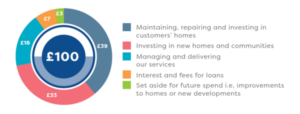
Read our latest reports to see we’ve invested money in our homes and neighbourhoods.
Your service charge covers the cost of services provided to your scheme, neighbourhood and personal charges in relation to your home. The charge is calculated annually based on the cost of services you receive for the previous year and estimated costs for the coming year. You only pay for services that you are provided with.
We always work to ensure the best value for money for customers through competitive tender processes for all suppliers. However, the economy has been challenging in recent years and as a result we continue to see increases in the costs of delivering essential services, such as building safety and compliance.
We have brought some services inhouse, such as grounds maintenance, cleaning and waste management, which means that we can better control costs than if we had continued to use external contractors. We have also reviewed data to capture the full and accurate costs of delivering services, which means some customers may see changes in their service charges.
Please take a look at the following frequently asked questions, which we hope will answer any questions you may have. This includes a full breakdown of the different service charges and what these cover. If you have any other questions, please get in touch.
Your service charge covers the cost of services provided to your scheme, neighbourhood and personal charges in relation to your home.
The charge is calculated annually based on the cost of services you receive for the previous year and estimated costs for the coming year.
Every type of service we can charge via service charges are listed in the table at the end of this document, with an explanation of what they cover. Not all of the services listed are necessarily provided where you live, so where you do not receive a service, it will not be included in your charge. You will only pay for the services you are provided with.
We always work to ensure the best value for money for customers through competitive tender processes for all suppliers. However, the economy has been challenging in recent years and as a result we continue to see increases in the costs of delivering essential services, such as building safety and compliance.
We have brought some services inhouse, such as grounds maintenance, cleaning and waste management, which means that we can better control costs than if we had continued to use external contractors. We have also reviewed data to capture the full and accurate costs of delivering services, which means some customers may see changes in their service charges.
If you have any concerns about your service charges or questions, please get in touch.
You only pay for the services that are provided directly to your house or in the building and/or area that you live.
There may be rare circumstances where a neighbour pays a different amount. An example of this might be where you pay for the maintenance of a communal garden, but your neighbour has their own garden. Or in some cases, you might have different terms in your tenancy agreement around non-charge weeks. If you have any queries please get in touch.
If you receive Housing Benefit or Universal Credit, the majority of your service charges will be covered apart from individual charges. More information about individual charges is included in the table at the end of this document. If you’re unsure, please contact our Money Advice Team by calling 0300 555 0600 or emailing moneyadviceteam@onward.co.uk.
If you are worried about your service charges, please contact our Money Advice Team. We can offer support to help with your finances or support in helping you find employment, so please get in touch.
Our Onward Environmental team provides grounds maintenance, cleaning, window cleaning, and waste management service for most customers. Most internal communal areas are cleaned fortnightly, with some properties and older persons schemes being cleaned more frequently. Window cleaning takes places usually every two months or as stated in the property agreement.
Grounds maintenance visits take place every two weeks. Litter picks are carried out on all visits. Grass is cut during the growing season, except in cases of extreme wet weather, and hedge and shrub reduction works are carried out from November to February. Some grassed areas, for example meadows, may be cut less frequently.
For those customers that receive a service from Onward Environmental, we will send a newsletter which sets out the services that we provide and when you can expect to receive these. You can find out more by visiting our website or giving us a call.
The table at the end of this document sets out the different service charges and explains what these cover. In response to customer feedback, we have broken service charges down into individual charges to make it clearer what you pay for.
We review service charges every year to ensure customers are charged fairly and accurately for the services they receive. As a result, in some cases, you might see that we have added a new charge which you have not been charged for before. This is where a new service has been added or when we have reviewed charges and found that you have not been paying for a service that you have been receiving from us.

If you think you’ll struggle to pay, please let us know as soon as you can. We’ll work with you to find a solution and discuss affordable repayment plans.
Our promise is that no one will lose their home where they are working with us to make payments.
We also offer a range of additional support for customers, from advice on how to manage your finances to help with hoarding.
We’re here to help you at your own pace.

Get free, confidential advice from our Money Advice Team.

Enhance your skills with training and support.

Need to speak to us about something else? We’re just an email or phone call away.